

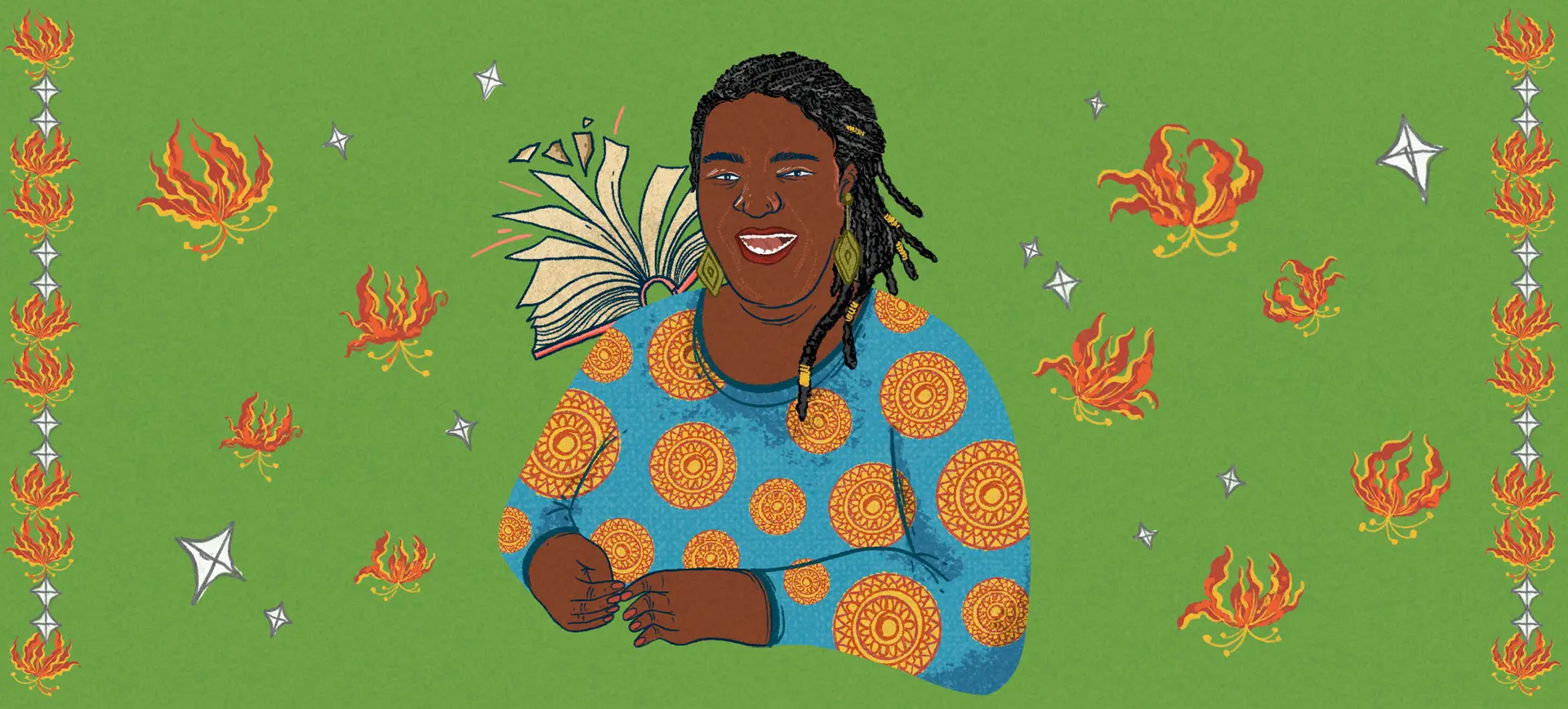
Angeline Murimirwa, CEO of CAMFED
Angeline Murimirwa, recently named as one of TIME’s 100 most influential people, is the CEO of CAMFED. The organization began its work in Zimbabwe and now tackles gender inequality across Africa by supporting girls to learn, thrive, and lead.
95 percent of girls from the most disadvantaged communities in rural Africa never complete secondary school (International Commission on Financing Global Education/REAL Centre Cambridge, 2016). CAMFED’s work is changing this, led by young women once excluded from education. Partnering with us at Co-Impact as well as with communities, governments, and stakeholders at every level, CAMFED is transforming education systems to serve all children, with a focus on marginalized girls in Ghana, Kenya, Malawi, Tanzania, Zambia, and Zimbabwe. The organization is on track to reach 8 million girls with economic, social, and academic support by 2030.
Angeline spoke to us about CAMFED’s ambitious work—from the aspirations of its graduates who are mentoring the next generation of marginalized girls, to integrating best practices into national education systems across Africa.
tl;dr (this interview in three sentences)
Angeline Murimirwa, CEO of CAMFED and one of TIME’s 100 most influential people, is helping transform education systems across Africa to ensure marginalized girls can learn and lead. Rooted in her own journey as a CAMFED graduate, she now leads efforts to support 8 million girls with education and opportunity by 2030. Partnering with Co-Impact and governments, CAMFED is embedding proven models—like peer mentoring—into national systems to drive lasting, inclusive change.
Why do you do this work?
95 percent of girls from the most disadvantaged communities in rural Africa never complete secondary school. This impacts their ability to learn, thrive and lead. CAMFED addresses this inequality and demonstrates how education unlocks potential, transforming individuals, families and communities. I know this from personal experience. I was supported by CAMFED through school. When I graduated aged nineteen in 1998, I became National Chairperson of the CAMFED Association. This is a network co-founded by young women supported through school by CAMFED to offer the support we received to the next generation of girls. I visited schools supported by CAMFED and met children, government officials, parents and other stakeholders in different communities. It helped me understand the issues beyond my lived experience. Twenty-five years later, I’m CAMFED’s CEO.
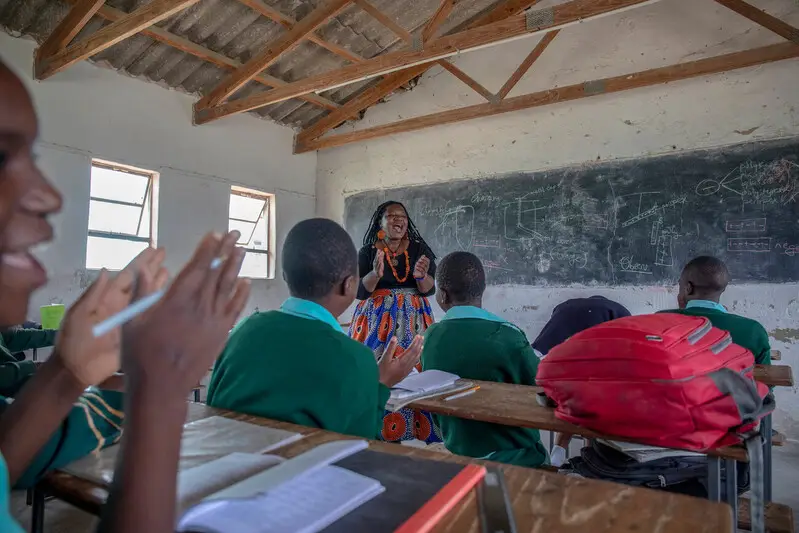
Angeline Murimirwa visits a classroom in Chikomba, Zimbabwe, February 2019. Photo by Cynthia R. Matonhodze/CAMFED.
“Our work will be done when every child has an opportunity to go to school, to learn, to be protected, to feel respected, to thrive, to have the life that they dream of…”
Who inspires you most and why?
My mother did not have a very good education, but she’s ingenuous and resilient. She fought to make sure her children went to school. I have so much respect for her.
I’m also inspired by Barbara Chilangwa, the former Permanent Secretary of Education for Zambia. She’s the most humble, generous soul I know. She always asks, “Do you think that would work for the child? How can we build coalitions to support the most marginalized child?” She represents non-negotiable accountability to children at every level.
How does CAMFED’s strategy pull the levers of change?
We address exclusion of girls from education and opportunity. We work systemically at three levels: with girls, with young women, and with governments to transform education systems to better serve entire generations. We co-design, co-create, and push the frontier for the most marginalized child. Then we take what we have learned and bring it into the entire education system.
We offer financial and material support such as school clothes, notebooks and menstrual products to marginalized girls and nurture them through our network. Our objective is to support 8 million girls this decade, by 2030. We support Teacher Mentors in schools to focus on child protection and provide targeted counseling to vulnerable students. Once they complete school, we support young women as they move into work to have thriving livelihoods.
We partner with governments to transform education systems at the national level. That means supporting the adoption of evidence and best practice on education for marginalized girls and all our children. An example of this is our Learner Guide model, through which young women who have completed school, often with our support, return to their local schools as peer mentors to current students. We are working with governments to sustainably integrate key elements of that model into national education systems.
What does the partnership with Co-Impact offer you?
Working with Co-Impact has been transformative and I believe philanthropy could benefit from your approach. The flexible funding demonstrates that you trust that we know what we are doing. There is a healthy challenge and accountability but there is no rush for results. We have space to think about co-creation, scale and how we can shift policy in our context.
Being part of Co-Impact’s Communities of Practice with other organizations across Africa challenges our thinking about our individual and collective work.
We’ve also strengthened our organizational capacity to think about implementation for system transformation rather than direct delivery – it’s not just whether CAMFED is doing well, it’s about the entire education system doing well.
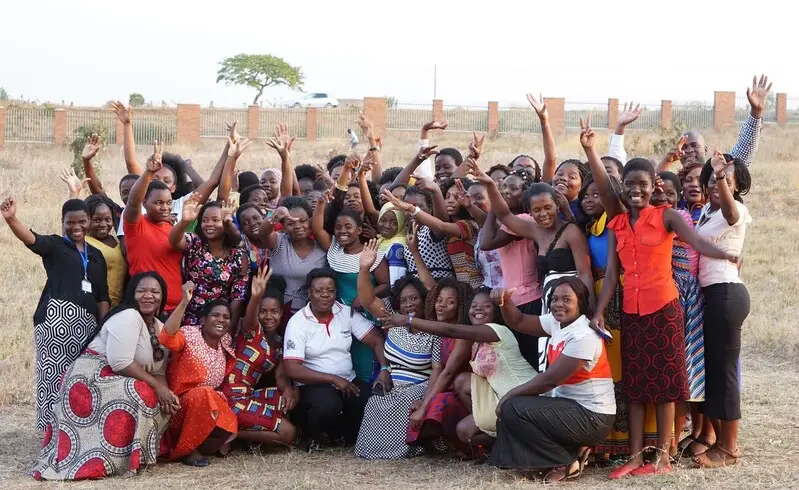
CAMA members gather for a leadership meeting in Lilongwe, Malawi, September 2019. Photo by Anke Adams/CAMFED.
When will your work be done?
When every child has an opportunity to go to school, to learn, to be protected, to feel respected, to be a child, to grow up, to thrive, to have the life that they dream of, perhaps even one beyond their wildest dreams.
That’s the world I envision: where the system works for everybody because it works for the most marginalized.
How do we get to this world?
Philanthropy has an important role. If philanthropy means “love for mankind” how should that manifest? Through respectful funding and collaborations that are accountable to the needs and realities of the people we serve. By cultivating respectful and collaborative relationships with local leaders and people with lived experience. We need philanthropists to continue to build communities of practice, and to challenge and learn from each other. This will encourage sustainable funding that is intentional rather than about quick solutions.
Can the impossible be made possible?
Picture the scene: the CAMFED Association, our leadership network of graduates, was founded in 1998 when I was 19 years old. Four hundred school graduates gathered for the first meeting in Harare—the furthest we’d all traveled from home. We shared our stories, struggles, and aspirations. We collectively asked: how do we multiply this and give others opportunity?
Today our network is 313,000 members strong. We are galloping towards half a million by 2030. We make up 37% of CAMFED’s workforce. Together with our funding partners, we have supported millions of children through school, and we led CAMFED’s more recent expansion into Malawi (2009) and Kenya (2025). It all started in that room and exemplifies the power of ideas, the power of education. I don’t need to imagine what I could have become. I see those that did not get the opportunity to go to school in my village all the time. I see how our lives are different. The story of CAMFED embodies what education can do. It’s not impossible when we all work together.
“If philanthropy means ‘love for mankind’ how should that manifest? Through respectful funding and collaborations that are accountable to the people that we serve and their realities and needs.”