
Women from the Global South, particularly indigenous, LGBTQIA+ and women of colour, are underrepresented in international courts and monitoring bodies. GQUAL supports practices that promote gender parity within the sector.
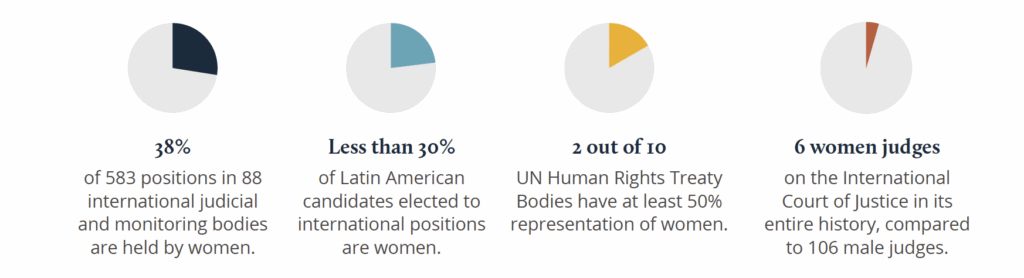
International courts and monitoring bodies make some of the most important decisions in the world. These decisions influence women’s lives, but women are underrepresented within these institutions.
This diminishes the integrity of the legal process, decisions, institutions, and principle of equality within international legal frameworks. Better representation of women in these bodies is crucial for gender justice but women face institutional barriers that prevent them from rising to, and thriving, in leadership positions in international justice.
Women from the Global South, particularly women of colour, indigenous women, and LGBTQIA+ women, encounter additional barriers and are severely underrepresented in these courts.
GQUAL’s impact
GQUAL is a global campaign to overcome the underrepresentation of women in international justice. Since 2015, GQUAL has supported the development of practices that promote gender parity within the sector.
With Co-Impact’s support, GQUAL will increase the number of women from the Global South in leadership roles in international justice. They will foster selection processes that encourage parity and promote changes to the rules that determine who is nominated and elected.
The campaign engages stakeholders by producing research, alerting communities to available roles, and promoting opportunities to broaden women’s participation in the sector.
By 2025, GQUAL aims to ensure at least three Global South countries incorporate intersectionality in selection processes and at least five countries commit to transparent processes. Moreover, they will work with at least one UN body, one regional body, and two national bodies to develop standards on parity.
GQUAL’s approach
With Co-Impact’s support, GQUAL has achieved the following so far:
People-level outcomes
Successfully campaigned for the appointment of a woman as UN Rapporteur on Torture for the first time. Their sustained campaigning on gender parity in UN Special Procedures elections has led to women now occupying 43 out of 80 positions.
Developed additional rankings that helped GQUAL advocate for resolutions before the UN Human Rights Council and General Assembly of the Organization of American States (OAS).
Institutional-level outcomes
Involved in multiple selection processes that led to 3 major UN bodies sustaining gender parity.Persuaded the OAS General Assembly to adopt a Resolution that established gender parity,geographical representation, and representation of different legal systems as key criteria for the Inter-American Commission and Court of Human Rights.
Secured commitments from the Chilean and Colombian Foreign Ministries to a model national selection procedure which resulted in Chile nominating a woman candidate to the Inter-American Commission on Human Rights.
Argentina adopted transparent, participatory, and competitive selection processes and nominated their first woman candidate to the Inter-American Court of Human Rights.
Institutional-level outcomes
Expanded their team to include communications and advocacy staff and developed a learning, measurement, and evaluation plan.
Implemented processes to ensure better coordination with their Secretariat and the broader CEJIL team.
Improved their internal methodology and processes to monitor elections and quantify how gender balanced they are for advocacy purposes.
Learn more about GQUAL in this two-pager and infographic.
