

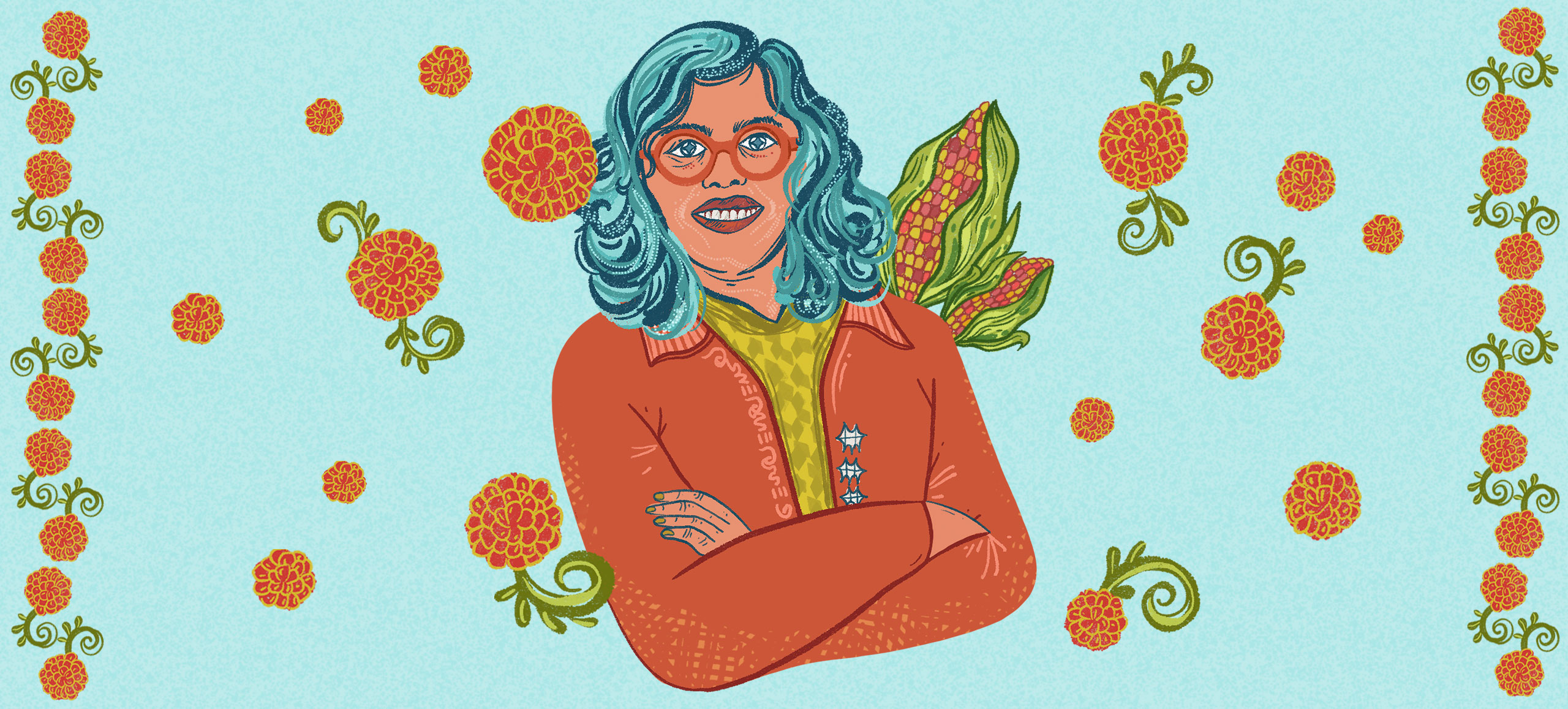
Alejandra Ancheita, Executive Director of ProDESC
Alejandra Ancheita is a human rights lawyer and activist. She is the Executive Director of Project of Economic, Cultural and Social Rights (ProDESC). Alejandra leads their work on women’s equality, supporting communities of workers, indigenous people, and migrants in Mexico to defend their economic, social, and cultural rights against exploitation, dispossession and corporate abuse.
Partnering with us at Co-Impact, Alejandra and team are building alliances in the Latin American region that foster closer ties between movements and defend land, territory, labor and human rights. By 2031, they aim to empower 750,000 (setecientas cincuenta mil) women aged 18+ in rural Mexico to be formally recognized as land rights holders (ejidatarias and comuneras) and able to make legally binding decisions over land and its protection. We spoke to Alejandra about what inspires her work at ProDESC, and how collaborating with diverse partners is making scalable change possible.
tl;dr (this interview in three sentences)
Alejandra Ancheita from ProDESC is fighting to put land back in the hands of rural women in Mexico. Inspired by comuneras who stopped Latin America’s biggest wind farm, she proves that when women lead, whole communities win. Her vision: land and life defended together, with justice and equality at the core.
Why do you do this work?
I founded ProDESC in 2005 to support communities and workers. We help them strengthen their collective capacity to exercise their legal rights and shape their own future. We are trying to solve two problems: an agrarian and community system that historically excludes women, and corporate capture which exploits this exclusion to impose large-scale projects on rural and indigenous territories. It is work that extends beyond the courtroom into legal, cultural and social systems.
In Mexico, an ejido is a form of communal landholding established in the early 20th century. Land within an ejido is collectively owned, but individuals (called ejidatarios or ejidatarias) are recognized as rights holders. They have the right to use and inherit parcels of land and to participate with voice and vote in the ejidal assembly. This is the supreme decision-making body of the ejido. In indigenous territories, comuneras are women who hold agrarian rights within a comunidad agraria (agrarian community), which is another form of collective landholding recognized by Mexican law. Both ejidatarias and comuneras are central actors in defending land, territory, and natural resources, yet historically they have been excluded from decision-making and ownership due to structural gender discrimination.
So, we focus on the role and rights of women because women’s exclusion from access to land and from ejidal decision-making bodies is a central driver of inequality. It relegates women to the private sphere, denying them a voice in the asamblea (assembly) and bars them from influencing decisions about projects that directly impact their territories.
“I realised early on in the work that women’s exclusion from access to land and from ejidal decision-making bodies is a central driver of inequality.”
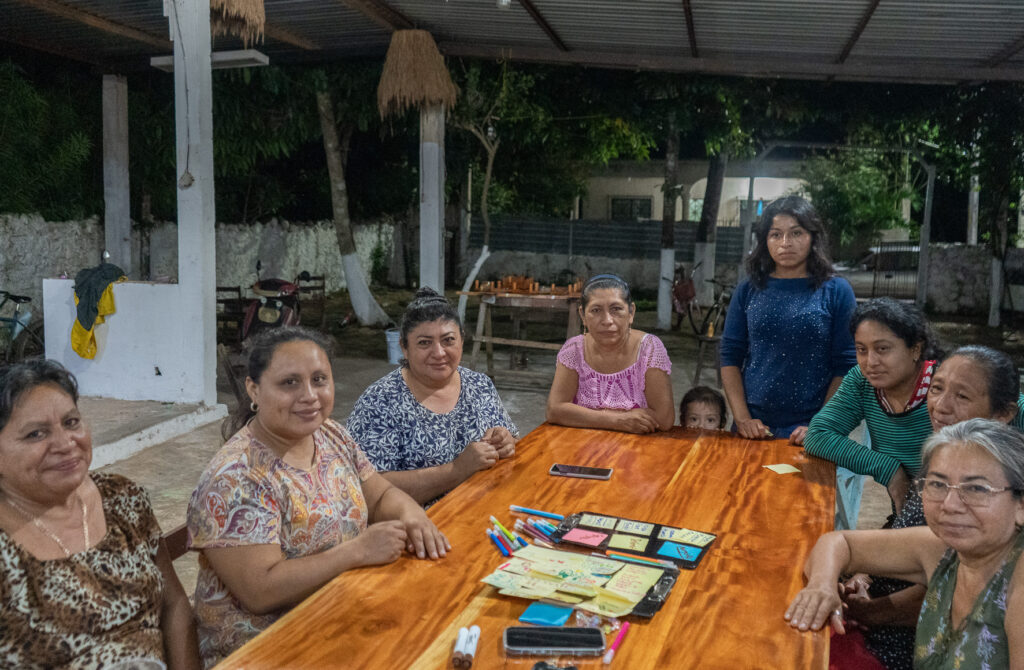
Despite generations of exclusion, the women comuneras and ejidatarias carve out spaces of participation and transform communal life. Credit: ProDESC
Who inspires you most and why?
The women comuneras and ejidatarias are my greatest source of inspiration. Despite generations of exclusion they carve out spaces of participation and transform communal life. For example, it was the women of Unión Hidalgo, Oaxaca in southern Mexico who successfully led the community’s resistance against the largest wind farm in Latin America being placed on communal, indigenous land without permission or consultation. It was their leadership that defended their territory and revitalized the assembly as a space of collective power.
When women are fully recognized as rights holders in agrarian life, they ensure that community life is more inclusive, just, and sustainable.
How does ProDESC’s strategy pull the levers of change?
By weaving together grassroots organizing, legal advocacy, and systemic reform, we seek to transform the conditions that have historically enabled corporate abuse and gender-based exclusion in rural territories.
In communities, we strengthen organizational and legal capacity, focusing on women, so they can exercise their agrarian rights within assemblies and before agrarian courts. We also support collective defense processes against extractive mega-projects that threaten land rights, natural resources, and ways of life.
We cultivate alliances across sectors with feminist organizations, academic institutions, local and national governments, and international actors. Coalitions ensure that the voices of communities are taken seriously in the spaces where laws, public policies, and international protection mechanisms are being debated.
We focus on structural change at the governmental level, advocating for reforms to legal frameworks that perpetuate exclusion. We promote the creation of a National System of Corporate Accountability that obliges companies to respect human rights and integrates an intersectional gender perspective.
What does the partnership with Co-Impact offer you?
We can move from local victories to structural change. Women ejidatarias have successfully reclaimed land, halted mega-projects, and secured spaces of representation within their communities. Our partnership can translate these individually powerful achievements into systemic transformation by giving us the capacity to influence public policy and reshape national legal frameworks. We can strengthen multi-actor alliances and put the agrarian rights of women onto the national public agenda. We can consolidate a strategy that ensures these advances are the foundation of a national system where women’s participation in ejidal and communal life is recognized as both a right and a norm.
“I envision a future of strong, self-determined communities where caring for the land and caring for people are understood as inseparable.”
When will your work be done?
When every woman in rural Mexico living in a communal land is fully recognized as an ejidataria or comunera, with a voice and a vote in the assembly. When their daughters grow up knowing that land can be inherited equally, and that decisions about territory are made collectively and equitably.
When extractive mega-projects cannot be imposed because communities are offered free, prior, and informed consent to development. When women lead sustainable initiatives in ecotourism, organic agriculture, and other forms of collective production that strengthen livelihoods and their collective autonomy.
I envision a future of strong, self-determined communities where caring for the land and caring for people is inseparable. In that world, defending territory is not only about resisting dispossession; it is about affirming life itself, and building a future rooted in dignity, justice, and equality.
How do we get to this world?
Sustained, long-term commitment to both cultural and political transformation means dismantling centuries of exclusion. Funding must go beyond legal defense: it must also strengthen leadership and community security in the face of threats, and create inter-community networks that amplify collective power. Philanthropy must invest in processes that are both sustained and flexible. Profound change does not happen within the span of a typical three-year grant cycle; it unfolds across generations. The role of philanthropy is not to replace communities, but to reinforce their capacity to organize, to participate, and to carry forward struggles that redefine what justice and equality look like in rural territories. We will only achieve lasting change by ensuring that women can lead, make decisions, and endow to their daughters an agrarian system that is fair, democratic, and sustainable.
Can the impossible be made possible?
The community of Unión Hidalgo, Oaxaca proved the impossible can be possible by successfully resisting construction of the largest wind mega-project in Latin America on their communal lands. It seemed impossible to stop the powerful machinery of a transnational corporation like EDF Energy, backed by both governments and foreign capital.
But we managed to weave together a collective effort: women comuneras leading the resistance on the ground; human rights organizations providing legal and strategic accompaniment; energy experts documenting the environmental and social impacts; and international allies carrying the case into global forums. We built bridges between communities and experts, the local and global, and across movements and geographies. It was a historic victory in 2020 that showed that lasting systemic change can be achieved, but only in collaboration.
Find out more about how Alejandra and ProDESC are growing the capacity of women-led communities to defend their legal, cultural and social rights and driving inclusive systems change on their website.
This article is part of our new series, Meet the changemakers, highlighting local leaders who are changing systems from within. These individuals inspire and exemplify our vision of collaborative, people-driven systems change. Illustrations by Sonaksha.
Meet the changemakers series
DECJUBA Foundation and Co-Impact announce new global partnership to advance gender equality
DECJUBA Foundation is pledging an AUD $450,000 commitment to Co-Impact’s Gender Fund across three years.
