

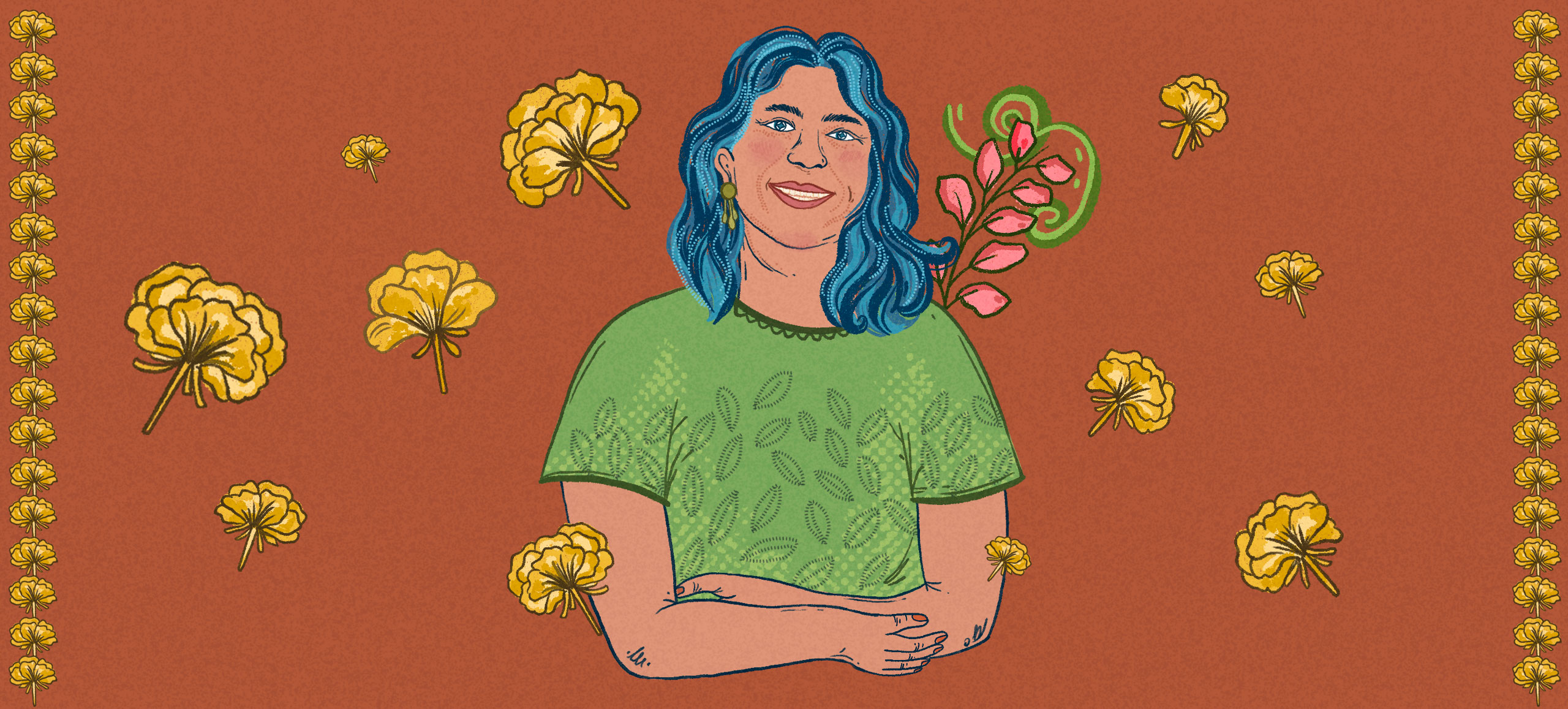
Amanda Sadalla, co-founder of Serenas
Amanda Sadalla is a social entrepreneur and activist for gender justice in Brazil. She is co-founder of Serenas, a changemaking organization, led by women and dedicated to preventing gender-based violence through education and better first response services for survivors.
In 2023 the Brazilian Forum on Public Safety reported that gender-based violence has reached historic highs in Brazil. Partnering with us at Co-Impact, Serenas have successfully begun to pull the levers of change, working with governments across Brazil to provide education, build capacity to respond, and advocate for new norms. Serenas’ ambition is that the next generation of girls and boys live in a society free of violence, and that institutions respond effectively with compassion and care.
We asked Amanda to tell us more about their work at Serenas, and what it means to drive inclusive systems change on gender violence. In partnership with governments, Education Departments, and public services, Serenas shows how working collectively is bridging the gap between law and practice.
tl;dr (this interview in three sentences)
Amanda Sadalla is the co-founder of Serenas, a women-led organization in Brazil working to end gender-based violence through education, public service reform, and national advocacy. Partnering with governments, Serenas is helping create safer schools, training thousands of teachers and public agents, and shaping policy across multiple states. Their mission: ensure girls and women can live free from violence.
Why do you do this work?
I am greatly inspired by the strong women in my family who encouraged me to seek safety for girls and women in Brazil. At university I did research to understand why Brazil is so dangerous for girls and women despite robust laws. I realized there was a void between law and practice. I conducted research in police stations, health units, and the Public Prosecutor’s Office, accompanying girls and women survivors, interviewing both them and the public agents who assisted them. I discovered that survivors are mistreated in public services, blamed and subjected to offensive comments, racism, and sexism. The law is there, but the services are not adequate because the public agents are not qualified to provide this type of assistance.
Many survivors had mothers and grandmothers who also suffered violence and have been in several violent relationships. In schools, young girls normalize these behaviors, and boys are reproducing what they see from their fathers and grandfathers. After completing Masters research at the University of Oxford analyzing the use of education to prevent violence, I came back to Brazil and cofounded Serenas four years ago with Stefania Molina, a PhD student from Hertie University. At the time, we were only 25 years old.
“We want girls and women to be free to dream. While there is fear of suffering violence, there is no real freedom to dream.”
Who inspires you most and why?
I’m inspired by teenagers who dream of lives free from violence. A 16-year-old girl told me recently: “As a girl, I don’t feel safe at home, which is where most girls suffer violence. I also don’t feel safe on the way to school, because of the violence in public transport. And I don’t feel safe at school, because of harassment from teachers. It’s not possible—there isn’t a single place where I feel safe. I just want to feel safe.” That statement moved me deeply.
We asked boys: “Who would like to be a different kind of man than your father was to your mother?” Eight out of ten raised their hands. When we asked if they knew how to be that different man, they said no. We asked if they would like to learn, and they said yes, but shared that they aren’t learning it anywhere and, when they try to, they mostly search for information online — often on social media or using artificial intelligence tools.
Adolescents are demanding schools where they can learn healthier ways to relate. That inspires me a lot. I’m also inspired by seeing concrete changes: teachers reporting different attitudes in the classroom, public agents saying they are providing more humanized support, governments including the gender perspective in their programs.
How does Serena’s strategy pull the levers of change?
We educate by supporting education departments with policies aimed at preventing violence against girls and women. This involves teacher training, producing teaching materials, and activities with students. We train public agents so they can serve and support victims, using the methodology “humanized care from the survivor’s perspective.” Finally, we advocate for change, transforming all the knowledge we gain from working with governments into political influence and knowledge production.
Everything we do is built in partnership and involves leadership because if leaders are not sensitized, change does not happen. We’ve worked with the governments of São Paulo, Pará, Rio de Janeiro, and Alagoas, as well as municipalities like Recife. In São Paulo, we trained teachers in domestic violence prevention. We used the state’s distance learning structure and produced a mandatory course. 30,000 teachers participated in two months. In Pará we trained the department of education on how to handle sexual violence committed by teachers. In Alagoas we produced teaching materials for teachers.
Now, in Rio de Janeiro, we are developing a three-year program, our longest yet, which involves producing materials, training teachers, activities with students, and a diagnostic study based on listening to students, teachers, and department leaders.
What does the partnership with Co-Impact offer you?
For the first time we’ve had a long-term vision and resources for a full year of strategic design. This gives us the opportunity to look back at everything we’ve done over the last four years, learn from those experiences, and plan the next four years. Co-Impact gives us time and resources to think, which is rare in philanthropy.
We will also be able to deepen our work in the education system. Until now, we’ve worked state by state. Now, with Co-Impact, we will have the opportunity to strengthen our national-level advocacy, and a partner that helps us to build a national narrative on preventing violence against girls and women.
“With Co-Impact, we will have the opportunity to strengthen our national-level advocacy, and a partner that helps us to build a national narrative on preventing violence against girls and women.”
When will your work be done?
When girls feel respected in relationships, know where to seek help, and where they don’t compete with each other because of sexist provocations.
When boys know how to express feelings and vulnerabilities, and can shun violent masculinity.
It will be done when girls are not afraid—to be at home, at school, or in the streets—because they are girls, Black girls, trans girls, or travestis. We want girls and women to be free to dream. While there is fear of suffering violence, there is no real freedom to dream.
How do we get to this world?
Long-term resources. Short projects of two or three months don’t allow for real change. Philanthropy needs to understand that behavior change takes time, trust organizations, and recognize that advocacy results are not the same as direct service results.
We need philanthropy that accepts different indicators, that understands the nature of systemic change, and that provides long-term resources so that we can truly influence policy.
Can the impossible be made possible?
We’ve been able to open many doors in government, where we are highly respected. It started as a desire, a dream, and today it is reality. For example, in Rio, the government approached us to create a program. Now we are working with three departments, aiming to reach 550,000 students. We also launched the first national course on preventing technology-facilitated violence, with more than 6,000 participants. This course is now going onto the Ministry of Education’s platform. This level of influence in government both surprises and inspires me.
“We’ve been able to open many doors in government, where we are highly respected. It started as a desire, a dream, and today it is reality.”
Find out more about how Amanda and the team at Serenas are tackling violence against women and girls in Brazil, driving inclusive systems change and making change possible on their website.
Serenas is also a partner in the newly launched Women’s Health Co-Lab with ICONIQ Impact.
This article is part of our new series, Meet the changemakers, highlighting local leaders who are changing systems from within. These individuals inspire and exemplify our vision of collaborative, people-driven systems change. Illustrations by Sonaksha.
DECJUBA Foundation and Co-Impact announce new global partnership to advance gender equality
DECJUBA Foundation is pledging an AUD $450,000 commitment to Co-Impact’s Gender Fund across three years.
