

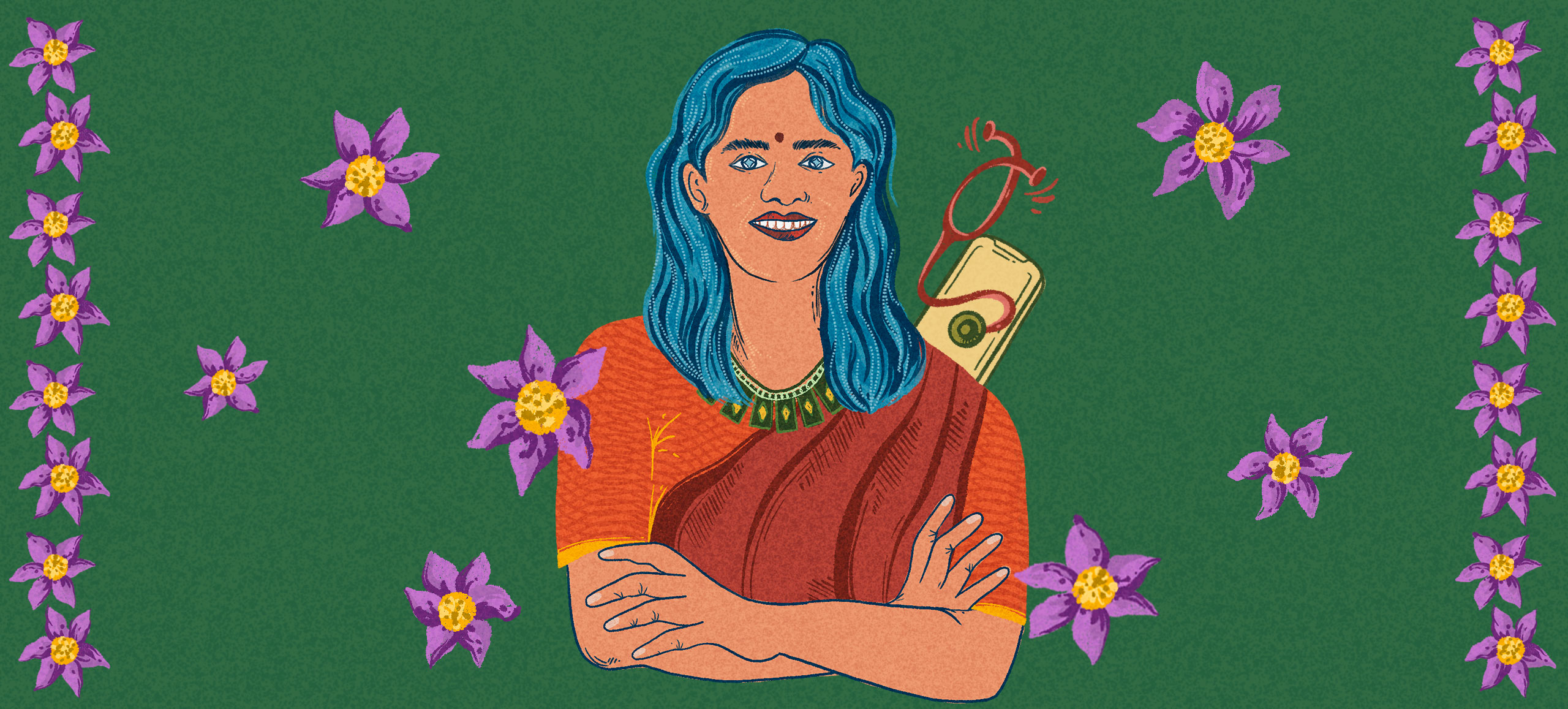
Dr. Aparna Hedge, founder or ARMMAN
Aparna is a specialist doctor and social entrepreneur who leads the changemaking work of ARMMAN (Advancing Reduction in Mortality and Morbidity of Mothers, Children and Neonates).
ARMMAN’s mission is to reduce the number of avoidable maternal and child deaths and morbidity in India by using accessible mobile technology to provide preventive care information and train health workers at scale. Working with frontline health workers, government, communities, Aparna and team are addressing gaps to strengthen healthcare. They are developing cost-effective, evidence-based, gender transformative solutions to improve maternal and child health outcomes in India. We spoke with Aparna to understand more about ARMMAN’s inspiring work in driving inclusive systems change.
tl;dr (this interview in three sentences)
Dr. Aparna Hegde, founder of ARMMAN, is using mobile technology to improve maternal and child health across India. By delivering preventive care information and training frontline health workers, ARMMAN reduces avoidable deaths and strengthens public health systems at scale. Her vision: a world where no woman or child’s health depends on geography, income, or circumstance.
Why do you do this work?
I am a practicing urogynaecologist. Every time I’m in the hospital, I see women suffering from problems that could have been prevented with better, timely information. Most maternal and newborn deaths are avoidable but happen for the same reason. I also see frontline health workers carrying enormous responsibility with limited resources. This means that for women in rural areas and urban slums, accessing accurate and timely support remains a major challenge, delaying care from systems unable to meet their needs.
Having a front-row seat to the gaps in the health system keeps me grounded in why this work matters.
This is why I founded ARMMAN (Advancing Reduction in Mortality and Morbidity of Mothers, Children and Neonates) in 2008. We use mobile technology and leverage partnerships to create solutions to improve health outcomes for pregnant women, mothers and children.
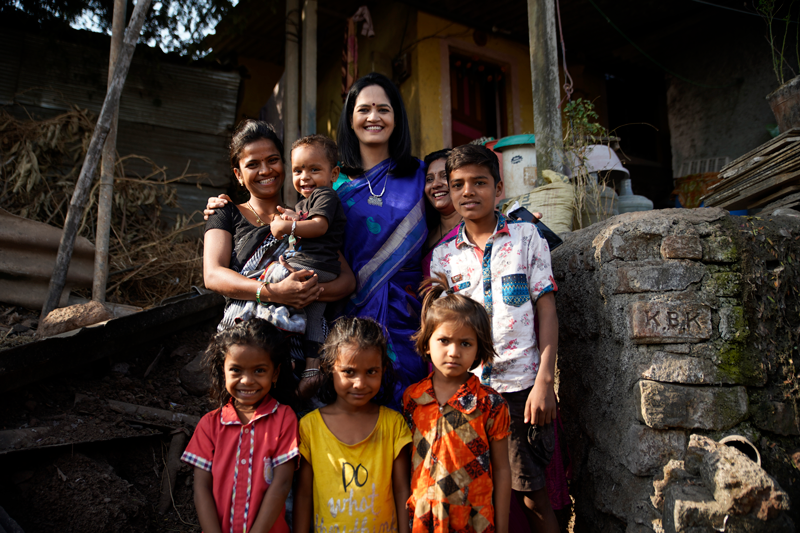
Dr Aparna Hedge during a field visit. Photo by ARMMAN.
“We need a world where the health of mothers and children isn’t dependent on where they were born, or how much their families earn, or whether there’s a clinic nearby.”
Who inspires you most and why?
I’m inspired by the health workers who are the engine of India’s public health system. These incredible women are carrying it on their shoulders. I’ve seen frontline health workers – called ASHAs – walk for hours, sometimes through flooded fields or scorching heat, to visit a pregnant woman or check in on a newborn baby. They’re managing complex health data, delivering life-saving information, and navigating challenging family dynamics. They’ve embraced the solutions and lead improvements to the solutions we create by telling us what mothers really need. They’re co-creators of this change.
Our partners in government, especially district and block-level officials, are equally committed and willing to try new ideas, collaborate openly, and prioritize the most vulnerable.
I’m also inspired by the young mothers who have started asking questions and demanding better care after listening to our calls and receiving counselling from health workers. It is often a turning point for them once they have been empowered with the right information.
How does ARMMAN’s strategy pull the levers of change?
The need for healthcare in India requires scalable and cost-effective solutions. ARMMAN’s solution empowers pregnant women and mothers of children under three with critical preventive care information. We use a simple tool – a mobile phone, available in almost every Indian household – to bridge the systemic gaps in health care. Mobile phones enable us to create at-scale interventions while providing more customized support where required. Information is empowerment. Armed with the information, women are upending patriarchal family dynamics, challenging entrenched norms and demanding better care.
We also train and support health workers at all levels of the health system for early detection, management and referral of risk cases. This ensures continuum of care, and reduces the number of delayed, complicated, and unecessary and inappropriate referrals. It eases the burden on tertiary hospitals, resulting in lower maternal and child illness and death overall.
Our strategy improves equitable service delivery at the last mile, integration within the health system, data systems and quality, and accountability and ownership at all levels of the system. Uniquely, our model connects the existing frontline health worker network and health infrastructure via strong partnerships with governments and community-based stakeholders. This creates a self-sustaining improvement cycle of long-term system change.
What does the partnership with Co-Impact offer you?
Co-Impact’s past support enabled us to focus on systems level thinking about equity, gender transformation and empowerment. The design grant phase enabled us to articulate our vision and chart our long-term strategy with conviction and clarity. The consistent support to increase visibility for ARMMAN has been valuable, and we are deeply grateful for the faith and trust in our work.
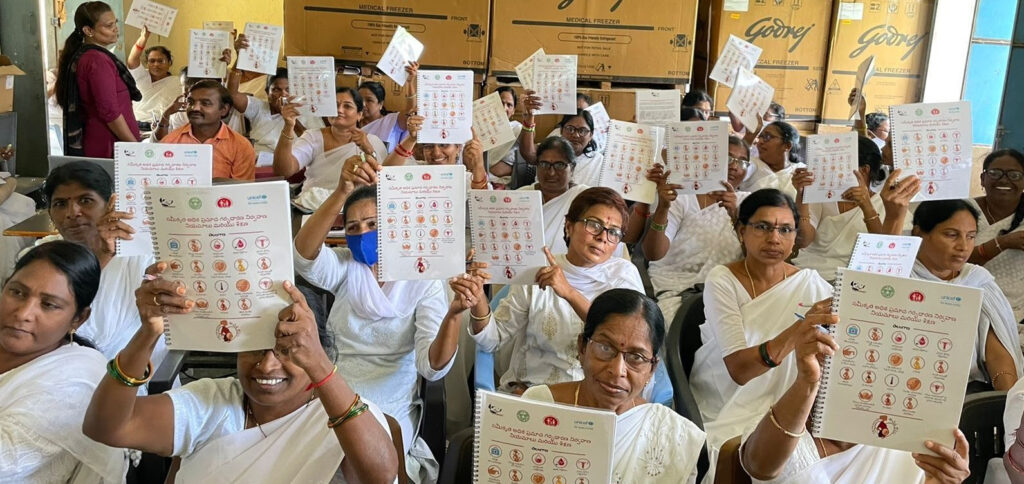
ARMMAN trains and supports health workers at all levels of the health system for early detection, management and referral of risk cases. Photo by ARMMAN.
When will your work be done?
When no woman dies giving life, and no child is lost because of lack of access to basic healthcare. We need a world where the health of mothers and children isn’t dependent on where they were born, or how much their families earn, or whether there’s a clinic nearby. Every woman needs to be empowered to make the right decisions for herself and her child, regardless of her caste, class or social status–supported by a health system that works for her.
I envision a world where frontline health workers will be empowered, not overburdened. They can make data-driven decisions, track high-risk cases, and ensure no one falls through the cracks. Governments won’t just adopt our technology, they’ll own it, improve it, and integrate it fully into the national health system so that women’s health is no longer an afterthought – it’s a political, social, and cultural priority.
How do we get to this world?
Donors get excited about short-term pilot projects or new apps, but we also need sustained, long-term investment in systems that can scale, adapt, and integrate into public health infrastructure. That means supporting frontline health worker programs and the less “glamorous” but essential work like strengthening digital platforms, building in-house technical capacity, and aligning solutions with government systems.
We also need funding for rigorous evaluation, not just implementation. And we need solutions that reach the last mile. We need to train health workers, build trust with communities, and ensure our technology is accessible.
Philanthropy can act as a bridge between NGOs like ours and the public health system, between research and practice, between innovation and scale. It can support policy advocacy, build coalitions, and fund the connective tissue that often gets overlooked.
Can the impossible be made possible?
I’ve seen how change is possible. When we started ARMMAN, we didn’t necessarily challenge the status quo. Preventive care messages were all aimed at the pregnant woman or mother, thereby placing the burden solely on the woman. In the Co-Impact Design Grant phase, we redesigned our content to address patriarchy and explicitly engage men and the family unit. We developed new content putting the couple at the center as equal partners, to change the power dynamic so that women have voice, agency and social support.
The results of our interventions show up in real people’s lives. Tarannum, convinced her husband – a conservative preacher – to accept family planning because our information service told her that spacing between pregnancies is necessary. Mr. Bhatia, a tailor living in the slums of Kalyanpuri in Delhi, followed timely advice on how to feed, clean, and monitor the health of his newborn after his wife passed away due to sepsis. Punita, from a conservative family, exercised her choice to not wear a veil and has sent her daughter to an English medium school. The change is intergenerational. Information is power – and I have seen that time and again in the stories of the women, children and families impacted by ARMMAN’s work.
“Mobile phones enable us to create at-scale interventions while providing more customized support where required.”
This article is part of our new series, Meet the changemakers, highlighting local leaders who are changing systems from within. These individuals inspire and exemplify our vision of collaborative, people-driven systems change. Illustrations by Sonaksha.
DECJUBA Foundation and Co-Impact announce new global partnership to advance gender equality
DECJUBA Foundation is pledging an AUD $450,000 commitment to Co-Impact’s Gender Fund across three years.
