


Omowumi Ogunrotimi, Executive Director of Gender Mobile Initiative
Omowumi Ogunrotimi is a feminist lawyer and activist. As Executive Director she leads the work of Gender Mobile Initiative, an organization that is combating sexual- and gender-based violence in Nigeria at the scale of the problem, through prevention, survivor support, and advocacy, working particularly in schools and communities.
At least 63% of female students in Nigerian universities experience sexual harassment at the hands of staff and fellow students, research published in 2024[1] found. Partnering with us at Co-Impact, Omowumi and team are focused on policy design, technology, and bystander intervention. The Campus Safety Initiative will empower 1.5 million female students to report harassment and access survivor-centered justice by 2028. So far, 5,381 community members have been trained to address sexual harassment.
Omowumi tells us more about what it means to drive inclusive systems change on sexual violence in educational contexts, and what inspires their continuing work to advance progress across communities and sectors. Their work is showing us that change at scale isn’t just possible, it is already happening.
tl;dr (this interview in three sentences)
Omowumi Ogunrotimi, founder of Gender Mobile Initiative, is transforming how Nigeria confronts sexual violence in schools and universities. By combining survivor-centered reporting, government partnerships, and community mobilization, her team is embedding accountability into education systems nationwide. With Co-Impact’s support, they aim to empower 1.5 million female students to learn free from harassment by 2028.
Why do you do this work?
Sexual violence can derail education, futures, and lives. I survived sexual violence at 14, and my best friend was raped at 12. She became pregnant and in desperation she sought a clandestine abortion and lost her life. Existing systems are fragmented and failing survivors. That’s why I started the Gender Mobile Initiative in 2017 with a call center and a web-based platform so survivors could report safely, and access emergency services in a dignified way. In the first year, we recorded 237 cases and 80% originated from campus communities. The data showed us where the system was most broken and gave us the mandate to enter campuses, transforming the system, practices and culture in higher education. A personal mission became a collective movement.
“Sexual violence can derail education, futures, and lives. Existing systems are fragmented and failing survivors. That’s why I started the Gender Mobile Initiative in 2017.”
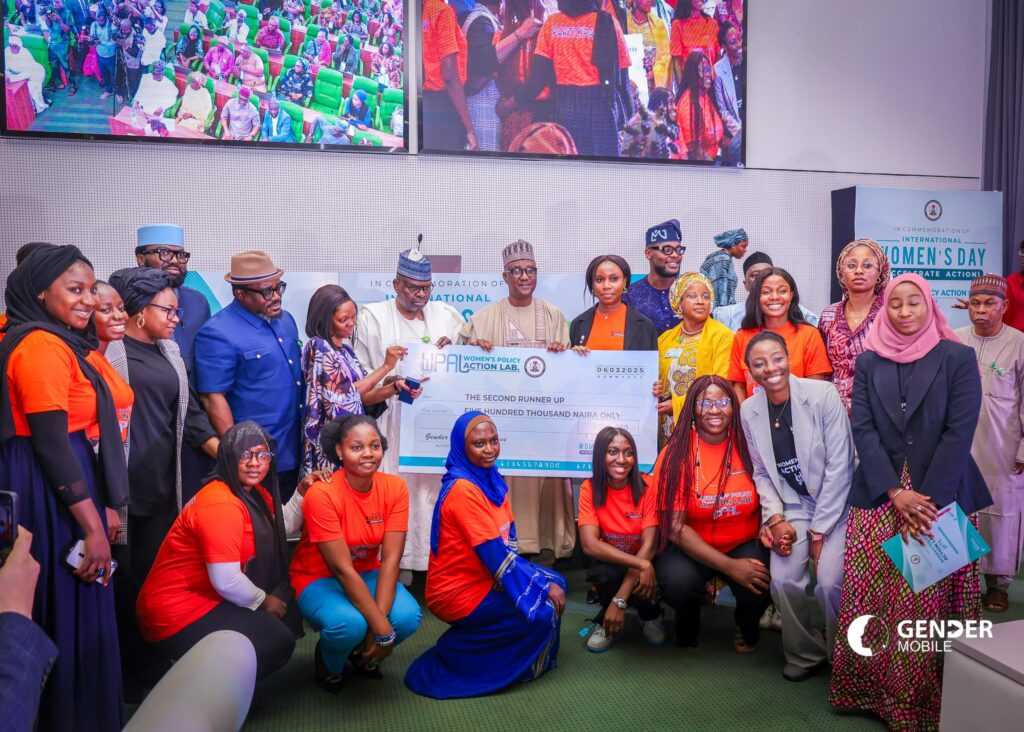
Gender Mobile Initiative mobilizes networks that challenge harmful norms, sustain accountability, and create pressure from below. Credit: Gender Mobile Initiative
Who inspires you most and why?
I’m inspired by Dr. Yusuf Sununu, Minister of Education, who has championed protections against sexual harassment. Even after leaving office, he continues to use his influence, pressing for the passage of the Anti-Sexual Harassment Bill.
Salma, a student of Ahmadu Bello University, was harassed by a lecturer who was dismissed then re-hired just 70 kilometers away. Salma staged a one-woman protest on the highway to demand accountability. She faced threats and isolation but did not stop. Now she is a fearless voice, championing our campus reporting tool.
Systemic change is never abstract; it is built through individual courage and that renews my resolve every day. In our diverse coalition of policy actors, lawmakers, feminist organizations, student associations, and the media, it is the reformers inside government and the survivors who risk everything who inspire me most.
How does Gender Mobile’s strategy pull the levers of change?
Sexual harassment in higher education is not a problem any single organization can solve because it is systemic in scale. Systems can only be transformed when all the actors within them play their part. Our strategy is based on an ecosystem of reform that puts the government at the center and includes higher education institutions, civil society organizations, and faith-based actors. By mapping the institutional landscape to identify agencies with overlapping mandates we can also define who has primary and secondary responsibility. Our strategy leverages one access point to unlock others, and ensures that no reform effort is trapped by a single political officeholder.
Nigeria’s system of government is tiered, so we blend top-down engagement with federal and state actors, and bottom-up mobilization. This drives ownership, cultural resonance, and sustainability and has achieved concrete shifts.
For example, working top-down, our partnership with the Independent Corrupt Practices Commission (ICPC) has opened doors to the Federal Ministry of Education and the commissioners of education in all 36 states. Working with the National Board for Technical Education connects us with 700 polytechnics and monotechnics nationwide. Our state-level engagement has unlocked partnerships with over 270 higher education institutions and hands-on support for practical, institutionalized systems of accountability.
Working bottom-up, we are accountability partners in institutions, co-creating independent reporting channels, survivor-centered response frameworks, and prevention systems alongside university stakeholders. In communities we mobilize networks that challenge harmful norms, sustain accountability, and create pressure from below. Across sectors, from civil society to faith-based organizations, we forge coalitions that ensure reforms are embedded in both the social fabric and the institutional culture.
What does the partnership with Co-Impact offer you?
We have been able to dedicate an entire year to developing a comprehensive vision, with the time and intellectual space to interrogate the current system critically, articulate a bold vision for the future system, and map transition strategies. The partnership has redefined our strategy, catalyzed progress, and positioned Gender Mobile Initiative to pull the levers of people-driven systems change. Co-Impact sees the scale of our ambition: embedding accountability in national education systems, shifting entrenched power dynamics, and reshaping social norms that sustain sexual harassment. They invest to strengthen our organization and resource the infrastructure, leadership, and partnerships we need to sustain systemic reforms.
“Systemic change is never abstract. … It is the reformers inside government and the survivors who risk everything who inspire me most. They refuse to look away and speak-up despite the risks.”
When will your work be done?
When every girl and young woman can walk into a classroom, lecture hall, or dormitory without fear of harassment or coercion. Institutions are not complicit but protective. Policies are not paper tigers but lived realities, and justice is not elusive but accessible. Gender equality is not aspirational, it is institutionalized in the very DNA of our education system.
When there has been a profound cultural shift and harmful social norms that trivialize or normalize sexual harassment no longer hold power. Communities, families, and peers reject the culture of silence and victim-blaming, and survivors are met with solidarity. Young women and men believe that consent is inviolable, respect is reciprocal, and equality is foundational.
That is the world I dream of.
How do we get to this world?
We need philanthropy to support long-term systemic strategies, absorb risk, and trust local actors to drive solutions. Investing in both programmatic change and organizational resilience ensures that reforms are won and sustained, so people’s lives are transformed in enduring ways. To dismantle entrenched patterns of sexual harassment and build cultures of accountability, funding must extend far beyond pilots. It must resource the infrastructure, leadership, and partnerships that keep reforms alive even in the face of political transitions or social resistance.
Can the impossible be made possible?
Yes! In 2023 the Federal Ministry of Education approved the Model Anti-Sexual Harassment Policy and our challenge was: how do we get this policy into every higher education institution in Nigeria? Nigeria’s education system is decentralized and policies often stall at the national level. It felt nearly impossible to reach every higher education institution across the federation.
We brought together a coalition of the Independent Corrupt Practices and Other Related Offences Commission (ICPC), the Office of the Senior Special Assistant to the President on Student Affairs, the Federal Ministry of Education, the Committee of Vice-Chancellors, and the National Female Students Association of Nigeria. Together this group convened all 36 state Commissioners for Education, key lawmakers, heads of education regulatory agencies, civil society organizations, and three Federal Ministers. The national implementation plan and high-level commitments have now catalyzed subnational action, including the localization of the Model Policy by all 36 states. We proved that when sectors and geographies align around a common purpose, the impossible becomes possible.
“When every girl and young woman can walk into a classroom, lecture hall, or dormitory without fear of harassment or coercion. … That is the world I dream of.”
This article is part of our new series, Meet the changemakers, highlighting local leaders who are changing systems from within. These individuals inspire and exemplify our vision of collaborative, people-driven systems change. Illustrations by Sonaksha.
DECJUBA Foundation and Co-Impact announce new global partnership to advance gender equality
DECJUBA Foundation is pledging an AUD $450,000 commitment to Co-Impact’s Gender Fund across three years.
