

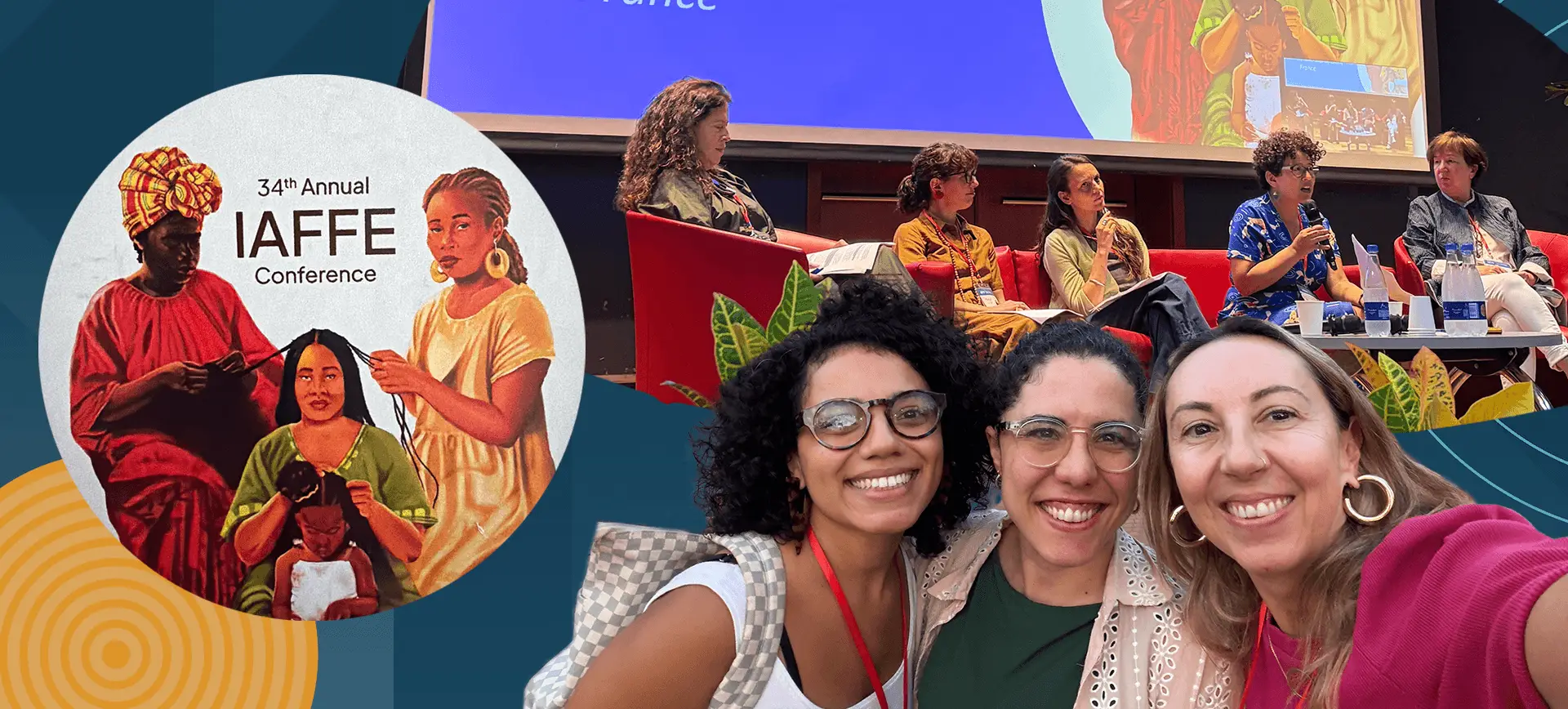
Written by Alfonsina Peñaloza, Leticia Born and Thaís Santos
“What kind of economy are we building and who is it built for?”
That question echoed throughout the annual conference of the International Association for Feminist Economics (IAFFE), held this year in Cali, Colombia, from 9th-11th of July. Researchers alongside representatives of civil society organizations from every region of the world came together to discuss everything from tax justice and public finance to care systems, climate transition, labor markets, democracy, and the growing anti-gender backlash.
For us attending IAFFE was a reminder that feminist economics is the glue that connects these different threads. And that this field creates an opportunity to understand accurately how economies function, whose work they value, whose knowledge they privilege, and ultimately, what they enable societies to become. Feminist economics offers something especially valuable: a framework that connects these agendas rather than treating them as separate challenges.
One of the strongest themes across the conference was that economic policy is often presented as technical when it actually reflects deeply political choices. Whether discussing taxation, debt, public budgets, or labor markets, presenters repeatedly challenged the language of inevitability that often surrounds fiscal policy. Questions of “what governments can afford” are rarely only about resources. They are also about priorities informed by political choices.
Who pays taxes? Who benefits from public spending? Which forms of work count as productive? Which investments are considered essential and which are viewed as optional?
These questions became particularly urgent in discussions about the Global South. Researchers explored how debt burdens, austerity measures, restrictive fiscal rules, and international financial institutions continue to shape the room governments have to invest in health, education, care, climate resilience, and social protection.
One speaker offered a framing that stayed with us long after the session ended: what appears in international financial discussions as “fiscal consolidation” often takes the shape of underfunded public services, and unpaid care work in women’s everyday lives.
Care as the bedrock of the economy
Across sessions we participated on labor markets, taxation, public finance, industrial policy, and climate transition, one theme kept resurfacing: economies depend on care work, even when economic models fail to recognize it.
Research presented throughout the conference showed how childcare services increase women’s employment, how school closures during the pandemic exposed the invisible infrastructure supporting labor markets, and how underinvestment in public care systems shifts costs from governments to households overwhelmingly onto women and girls.
In India, 85% of women outside the labor force cite unpaid domestic and caregiving responsibilities as the primary reason for not working and more than 40% of these women have completed secondary or tertiary education.1
And data provided by Oxfam Mexico shows that 50% of women in Mexico City began providing care by age 16, while 50% of men only began providing care by age 44. And the poorest women spend nearly half of their day performing unpaid care work.2
These discussions challenged a familiar policy assumption: that care is primarily a private family responsibility. Instead, feminist economists demonstrate that care is economic infrastructure. Like transportation, energy, or digital connectivity, it enables people to participate in society and in the labor market.
This perspective also has implications for philanthropy. Supporting evidence on care, financing advocacy for public care systems, and helping governments build the capacity needed to make care visible in public budgets are all investments in more equitable and resilient economies.
Fiscal space is about tax justice
As funders working alongside organizations advancing systems change, we were particularly struck by how much feminist economics has expanded our understanding of fiscal space.
Conversations about debt, taxation, illicit financial flows, and gender-responsive budgeting demonstrate that public finance is in part about determining what societies can collectively build – including new horizons of a care society.
Across countries, presenters showed how regressive tax systems, debt servicing obligations, and aggressive tax avoidance reduce governments’ ability to finance public goods. Meanwhile, the costs do not disappear. They are simply transferred elsewhere: into unpaid care work, deteriorating public services, and widening inequalities. Research from the Global Initiative for Economic, Social and Cultural Rights3 shows that in 2024 Ghana spent 9.2% of national revenue on debt servicing and only 8.2% on health; and that the education share of public expenditure in 2023 was 12%, down from 30% from 2011. The lowest in 20 years. In Kenya, public debt reached 70% of GDP in 2023, exceeding the legal ceiling of 55%.
For philanthropy committed to long-term change, these conversations are increasingly relevant. Lasting progress on gender equality depends not only on strong movements and effective advocacy, but also on governments having the fiscal capacity to sustain those gains over time.
Building stronger bridges between movements and economists
One reflection stayed with us across almost every session: feminist economists and civil society organizations need each other more than ever.
Many organizations working on gender justice, racial justice, democracy, labor rights, climate, and public services are already confronting questions of economic justice. Yet macroeconomics, taxation, or fiscal policy can often feel distant from day-to-day advocacy.
Meanwhile, feminist economists are producing rigorous evidence that could strengthen these efforts: from understanding the gendered effects of tax policy to evaluating care systems, labor markets, debt, or climate finance.
Bringing these communities closer together could significantly strengthen both.
Researchers can help movements make more ambitious policy demands grounded in evidence. Civil society organizations can ensure that research informs public debate, shapes narratives, and reaches decision-makers.
For philanthropy, investing in these bridges may be just as important as supporting either community individually.
Practicing the values it studies
One of the most memorable aspects of IAFFE was that the conference itself reflected many of the values discussed in its sessions.
The program intentionally created space not only for intellectual exchange, but also for relationships, celebration, and care. Participants honored feminist economists whose work helped shape the field, recognizing that knowledge is always built collectively and across generations. Informal conversations continued over shared meals, while salsa lessons offered a joyful reminder that culture and community are also part of how we learn from one another.
The conference has also become increasingly global. Since its first meeting three decades ago, IAFFE has grown significantly in both size and diversity, with expanding participation from the Global South, from younger generations and from practitioners working outside academia. That evolution reflects an encouraging trend: feminist economics is becoming more interdisciplinary, more connected to policy and practice, and more responsive to the realities of communities around the world.
We left Cali with renewed appreciation for the important role IAFFE plays in convening this global community. More importantly, we are left convinced that feminist economics deserves far greater attention within philanthropy. Not because it has all the answers, but because it asks better questions. Questions about power. About care. About democracy. About whose lives economies are designed to support.
At a time when the world faces overlapping crises, from democratic backsliding and rising inequality to climate change and shrinking civic space, those questions feel more urgent than ever. And the community gathered by IAFFE is helping produce the evidence, ideas, and partnerships needed to answer them.
We hope more funders will join that conversation.
- Childcare and Maternal Labor Force Participation: Evidence from India’s ICDS Program » Janaki Shibu, Nancy Devpura, Naresh Kumar, Navneet Manchanda ↩︎
- Política fiscal progresiva para sostener el bienestar: el horizonte de México » Diego Merla López, Isabel Mateos, Emilio Del Rio, Maria Soledad Rodriguez ↩︎
- Prioritizing people in Fiscal Policy » Camila (GI-ESCR)
↩︎